
Deepen, Expand or Pivot: Which Path Is Your Job On?
Every few weeks someone asks me a version of the same question: “Magda, will my job still be relevant in five years?”
I used to answer that with reassurance. Now I answer it with data — because the informed answer is more useful than the comforting one, and it turns out to be less scary than most people fear.
So let’s look at what the research actually says, not at what the panic-inducing headlines scream from our screens every day.
The numbers, without the spin
Here’s the reality check I keep coming back to:
- 39% of core workplace skills are expected to change by 2030 (WEF).
- Globally, 1 in 4 workers is in a job exposed to AI (ILO).
- 53% of jobs in Europe and 54% in the US are already exposed to generative AI in some form (OpenAI) — but exposure doesn’t necessarily mean replacement.
And here’s something that should get more attention than it does:
- 63% of young workers in Europe, and 69% in Northern America, are already in AI-exposed occupations — and over half of the skills that entry-level jobs now demand used to be senior capabilities (WEF).
- Women are predicted to be hit harder than men: McKinsey estimates that in the United States alone, women will account for 57% of all job transitions, even though they make up only 47% of the workforce. (We need more research on the specific impact on various minority groups — that piece is still largely missing.)
The disruption isn’t landing evenly. It will hit hardest the younger workers, who have less experience to prove, and women, especially those in assistant, secretarial and clerical roles.
If that’s you, I’m not going to pretend this is fair — it isn’t, and being told to “upskill” when the ground is moving under you might sound overwhelming… What I’d say is this: the roles most exposed are also the ones where the change is already happening, so every, even a small, deliberate move from your side carries a real value.
And there’s good news too. Most of today’s jobs, however exposed to AI they are, will usually change shape first before they disappear completely — which buys us time to adapt. What really determines your chances isn’t your age, your gender or your current job title. It’s whether you treat the AI transition as an opportunity to grow, or freeze and wait until you’re forced to adjust.
What’s actually on the rise
The fastest-growing skills (see the chart below) mix AI and big data, cybersecurity and technological literacy with creative thinking, resilience, curiosity and leadership. The pattern is the whole point: technical fluency plus distinctly human skills, together — not one instead of the other.
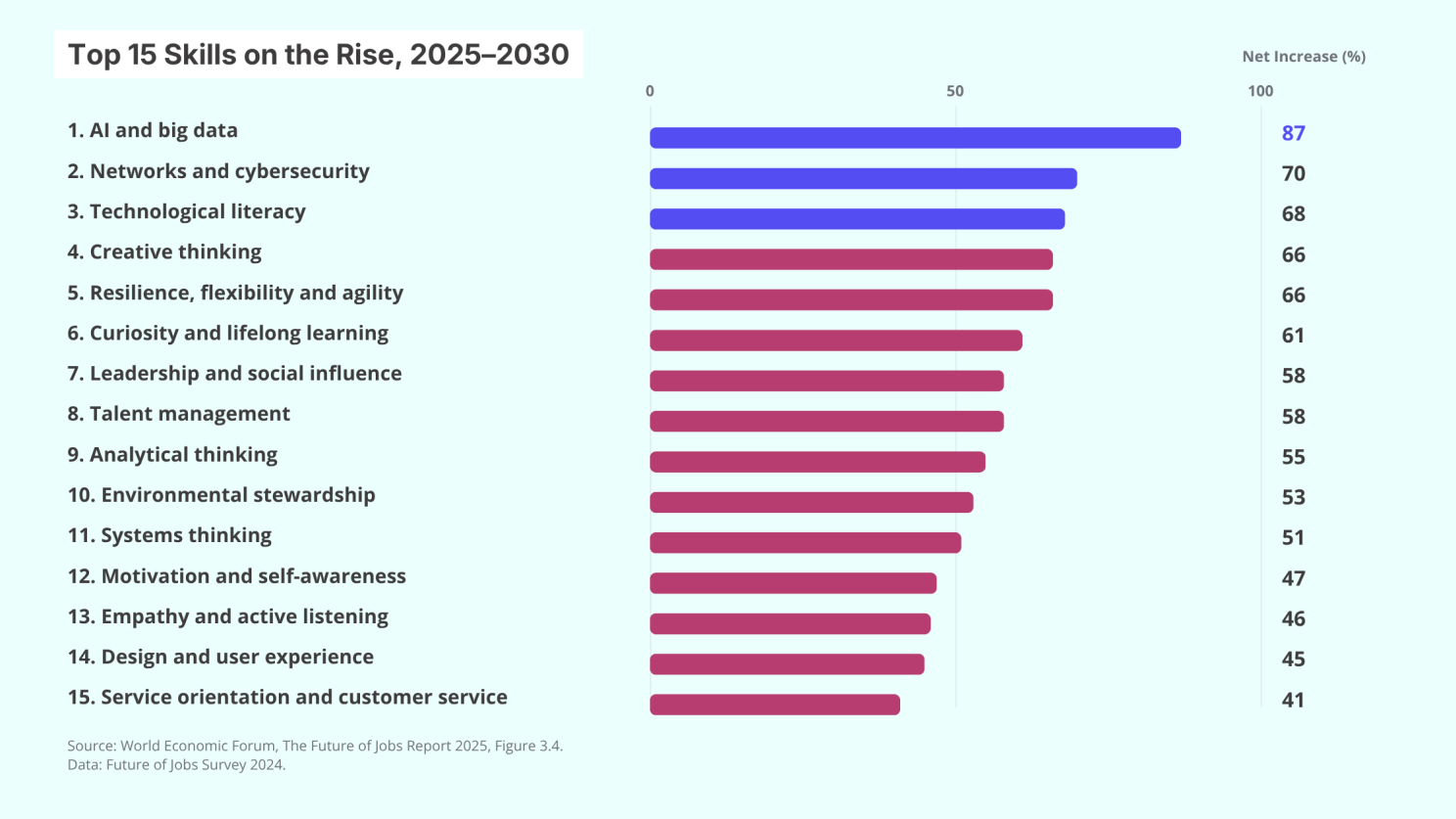
Important to note, AI literacy has become the sharpest differentiator in the market right now. Jobs requiring it have grown 70% in a single year, and workers who have it command a 62% wage premium globally. It’s the cheapest, fastest way to raise your market value, and stay on top of the transition that is coming anyway.
The three paths to rethink your professional future
When clients come to me looking for more clarity about their future careers, we don’t just talk about motivation, strengths and vision. We also map, honestly, which of these three paths they’re on today: Deepen, Expand or Pivot.
You can do this exercise on your own. Before you decide which path you’re on, answer these honestly:
- What share of your week is made up of tasks a capable stranger could do with a good AI tool and a clear written brief?
- How much of your value comes from judgement, relationships and context that exists nowhere in writing?
- When AI does part of your job faster — who captures that gain? You, or someone who then needs fewer people like you?
The three paths
Once you answered the three questions, it will be easier for you to place yourself on one of these three paths:
Deepen — your role holds up well against AI: it demands specialist knowledge and people skills, and it’s a complex bundle of intricate tasks that require judgement.
Your best move is to go further into your existing strengths and add AI fluency on top, so you become the expert who does the deep work faster and better, with AI as your assistant.
Expand — your role will likely be reorganised around AI, not eliminated by it. Some tasks will be automated or augmented; others — especially those requiring human judgement and relationship building — will stay as they are.
Your best move is to learn the adjacent skills that widen your opportunities in the same field. You want to become the person who integrates AI into how the work actually gets done.
Pivot — your role is under real automation pressure: most of its tasks are relatively simple and based on processing existing data, and they can be unbundled into smaller streams of work that AI can handle without human intervention.
Your best move isn’t panic — it’s recognising that entirely new roles are emerging, and that your experience transfers much further than you think. This is the path that needs the most courage and the least drama 😉
Nobody is simply “assigned” a path by some external labour-market force, with no choice or agency in the matter. Your challenge is to be honest about where you sit today — and then to act on it.
Your move this month
So what should that first step be? It’s September, and “Back to School” is in the air — so use it as a mental hook and put your upskilling plan into action.
Map your existing skillset diligently and honestly: your top technical and soft skills, your biggest strengths, the areas where you’d like to grow. Then shortlist two skills from the “on the rise” list — and commit to building one of them over the next 90 days (end of the year — an easy deadline!).
Not everything, everywhere, all at once. Not “tomorrow”. One skill, one timeline, so that by December you know you’re actively doing something about your professional future instead of passively waiting for it to happen.
The people who make the most of the AI transition won’t necessarily be the most talented ones. They’ll be the ones who saw the change coming and took the reins, rather than being swept along by it. I hope we’re all on that team.
Over to you 👇 Which of the three paths are you on — and what’s the one skill you’re committing to before the year ends? And if you want me to go deeper on who this transition hits hardest, or have any interesting sources to share, let me know!
— Magda
#MagdaKufrej #CareerCoach #WorkAlly #FutureOfWork #AIandJobs #CareerTransition
